







This guide explains how to read a VA Loan financed offer. It does not evaluate any buyer, and it is not legal advice.
A VA-financed offer should be read the same way as any other financed offer: by the terms written in the contract. VA financing does carry real procedural differences, including a required escape clause tied to the VA-established value and rules about which fees a veteran may be charged. But the financing label does not tell a West Valley Phoenix seller whether the buyer is strong, whether the sale will close, or whether the seller will net less. Those answers live in the offer itself, in current program rules, and in facts about the specific property.
That is general guidance about how to evaluate an offer, not a prediction about any transaction.
Near Luke Air Force Base, VA financing is a routine part of the buyer pool. For West Valley Phoenix sellers, understanding these offers is ordinary preparation rather than military-specific knowledge. Many sellers here used VA financing to buy the home they are now selling.

The short answer: is a VA offer bad for a seller?
No, and also not automatically good. Neither conclusion can be drawn from the loan type.
A financing label describes a process the buyer’s lender will follow. It does not describe the price, the requested concessions, the earnest money, the closing date, the contingencies, or anything else that determines what an offer is actually worth to you. Two VA offers on the same West Valley Phoenix home can differ from each other far more than a VA offer differs from a conventional one.
Read the contract before you rate the financing.
What the VA label tells you, and what it does not
What it confirms
The buyer intends to finance through a VA-backed loan, and certain program rules will apply to the transaction. The Department of Veterans Affairs does not lend the money — private lenders issue these loans with a VA guaranty behind them.
What it does not establish
It does not tell a West Valley Phoenix seller the buyer’s income, credit, reserves, or underwriting status. It does not tell you whether this sale will close. It does not tell you what you will net. And it does not tell you whether this offer is better or worse than the one next to it.
That cuts in both directions. “Zero down means the buyer has no money” is an unsupported inference — but so is “VA buyers are more reliable.” Both replace the contract with a shortcut. The useful move is to reject the shortcut, not to swap in a friendlier one.
The three concerns West Valley Phoenix sellers hear most
Three questions surface most often when a VA-financed offer arrives on a West Valley Phoenix home, and each has a real answer rather than a reassurance.
Seller concessions
Bold the label: Depends on the offer. VA rules limit certain fees that may be charged to a veteran, and they cap specific categories of seller concessions. Neither rule means a West Valley Phoenix seller automatically pays more.
Three different things get collapsed here, and separating them resolves most of the worry:
- Fees a veteran may not be charged. A program rule about the borrower.
- Closing costs that any party may pay. Buyer, seller, lender credit, or shared, depending on the transaction.
- Concessions requested in this offer. A negotiated term someone wrote into the contract.
Only the third is a number you are being asked to accept. A request for seller-paid costs is an offer term, not a characteristic of VA financing. The question is never “do VA offers cost sellers more” — it is “what is this offer asking me to pay, and how does that change my proceeds compared to the other offer on the table.” For how these costs are structured for West Valley Phoenix transactions, see VA loan closing costs in Arizona.
The strength of the borrower
Wrong assumption, in the specific form it usually takes. The absence of a down payment is a feature of the loan program, not a financial diagnosis. It says nothing about reserves, income, or capacity to perform.
What a West Valley Phoenix seller can actually evaluate is documentation. What did the buyer submit with the offer? What has the lender verified, and what remains conditional? A preapproval is meaningful information, but it is not a funding guarantee, and financing stays subject to underwriting and property conditions regardless of loan type.
Ask what has been verified. Do not infer it from a percentage.
The inspection
Depends on the property. VA financing includes property condition standards and a valuation process, so property questions are legitimate. They are questions about your West Valley Phoenix house, though, not about your buyer.
The distinction that matters most: the VA appraisal and a home inspection are different things with different purposes, and sellers frequently conflate them. That difference is covered in VA appraisal versus home inspection in Arizona, and the property standards themselves in VA minimum property requirements for Arizona homes.
The escape clause, which is genuinely different
Generally true, and worth understanding precisely.
Federal regulation requires VA purchase contracts to include an escape clause. Under it, the buyer is not obligated to complete the purchase, and does not forfeit earnest money, if the contract price exceeds the reasonable value established by the VA. The buyer may still choose to proceed at the contract price.
This is real, it is not negotiable, and it is one of the few places where a VA-financed offer on a West Valley Phoenix home differs structurally from a conventional one. It must be signed by both buyer and seller, and if a contract does not contain it, the contract has to be amended before closing. VA escape clause, Department of Veterans Affairs (external, new tab)
What it does not mean is equally important. It does not let the buyer walk for any reason. It does not prohibit a buyer from paying above appraised value. It does not require you to reduce your price. And it does not mean you have no protection.
It matters most when a contract price is running ahead of likely value. In conditions where offers routinely exceed asking price, this clause becomes a much larger part of the conversation. In conditions where they do not, it often never comes into play. That is why the useful question is about your specific West Valley Phoenix price and property rather than about VA loans in general. The valuation mechanics are covered in how the VA appraisal works in Arizona.
The one place a seller’s caution is warranted
Verify current rules. There is a meaningful difference between a buyer obtaining new VA financing and a buyer proposing to assume an existing VA loan. Those are separate transactions with separate consequences, and an assumption can affect the entitlement of the person whose loan is being assumed.
If an offer involves assumption rather than new financing, that is a genuine reason to slow down and ask specific questions. It is not the same concern as a standard VA-financed purchase, and it should not be treated as interchangeable. See how VA loan assumptions affect entitlement.
Most VA offers a West Valley Phoenix seller receives are new-financing purchases. Confirm which one you are looking at before deciding how much scrutiny the structure deserves.
How to compare a VA offer against another offer
The comparison problem is not VA-specific. For any West Valley Phoenix seller, headline price and loan type together still tell you very little.
Normalize both offers into the same fields before comparing anything:
- Contract price Requested seller contributions, and what they cover
- Earnest money and the applicable contract protections
- Closing date and who controls it
- Contingencies, and when each expires
- Property obligations either offer creates
- Possession and post-closing terms
- What financing documentation accompanies each
Then compare field to field. An offer at a higher price with heavier concessions and a longer timeline may leave you with less than a lower-priced offer that asks for nothing. Your price strategy and your offer evaluation are related but separate decisions, which is why pricing a West Valley Phoenix home is worth working through before offers arrive.
Apply the same fields to every offer on your West Valley Phoenix home. Consistency is what makes a comparison defensible, and it is also the discipline that keeps evaluation from drifting into something else.
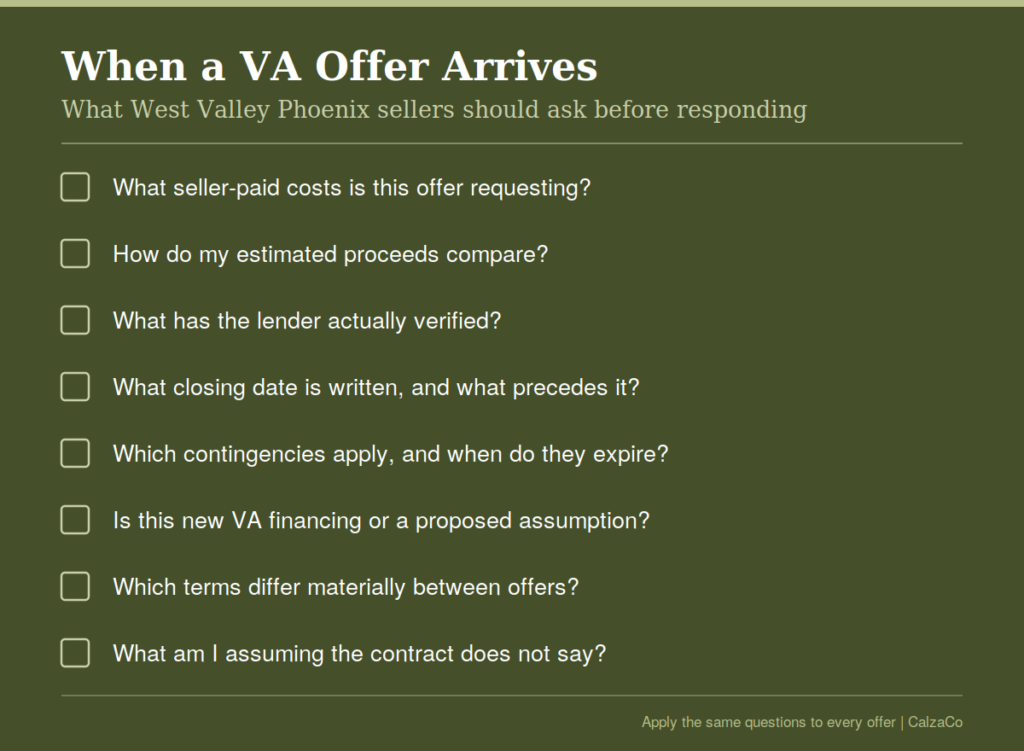
What to ask when a VA-financed offer arrives
- What seller-paid costs is this offer actually requesting, in dollars?
- How do my estimated proceeds compare between this offer and the alternatives?
- What financing documentation came with the offer, and what has the lender verified?
- What closing date is written, and what has to happen before it?
- Which contingencies apply, and when does each expire?
- Is this new VA financing or a proposed assumption?
- Are there property-specific questions I should resolve before responding?
- Which terms differ materially between this offer and the other one?
- What am I assuming that the contract does not actually say?
Notice what is absent. None of these ask anything about the buyer personally. They ask about the contract, the documentation, and the property, which is where the answers actually are.
A word on how you decide
West Valley Phoenix sellers evaluate offers, and there is nothing improper about scrutinizing terms carefully. What matters is that the scrutiny attaches to the contract rather than to the person on the other side of it.
Working through that with a seller is part of every listing we take on. You can see what listing with CalzaCo involves before you decide who to call.
Evaluate the terms for every offer on your West Valley Phoenix home. Consistency is what makes a comparison defensible, and it is also the discipline that keeps evaluation from drifting into something else.
Where to go from here
A property-specific offer review can compare requested concessions, estimated proceeds, contingencies, timelines, and property obligations across every offer on your West Valley Phoenix home, using the same fields for each. At CalzaCo we help sellers position their home strategically based on market conditions, buyer behavior, pricing, preparation, and negotiation. We break down every offer so the decision is yours to make with clarity, so you can move into your next chapter confidently.
Book a strategy session and we will help you build a clear plan, click here or call/text 623-242-2900.

Frequently asked questions
Should I accept a VA loan offer on my West Valley Phoenix house?
That depends entirely on the terms, not the loan type. Compare the contract price, requested seller contributions, earnest money, closing date, and contingencies against your other options. A VA-financed offer can be the strongest offer on the table or the weakest, and the label alone will not tell you which.
Does a VA loan cost the seller more money?
Not automatically. VA rules limit certain fees a veteran may be charged and cap specific concession categories, but that does not obligate a West Valley Phoenix seller to pay anything. Seller contributions are negotiated terms written into an offer. Look at what this contract requests in dollars and compare estimated proceeds across offers.
Does zero down mean the VA buyer is less qualified?
No. No down payment is a feature of the loan program, not a statement about the buyer’s income, credit, or reserves. Evaluate the financing documentation submitted with the offer and what the lender has verified. A down-payment percentage is not evidence of financial capacity in either direction.
Can a VA buyer back out if the appraisal comes in low?
The VA escape clause allows a buyer not to complete the purchase, without forfeiting earnest money, when the contract price exceeds the VA-established reasonable value. The buyer may also choose to proceed at the contract price. It is a required provision in VA purchase contracts and is not negotiable.
Do VA loans always take longer to close?
Financing type alone does not determine a closing timeline. The lender, file readiness, appraisal scheduling, property condition, and contract dates all matter more on any West Valley Phoenix transaction. Rather than asking whether VA loans are slow, ask what closing date this offer proposes and what has already been verified on this specific file.
What is different about a VA assumption versus a VA purchase?
They are separate transactions. A buyer obtaining new VA financing on a West Valley Phoenix home is not assuming an existing loan. Assumptions carry consequences for the entitlement of the original borrower and warrant specific questions. Confirm which structure an offer proposes before evaluating it.
+ show Comments
- Hide Comments
add a comment