







If you are weighing whether to sell your West Valley Phoenix home now or wait, the most useful thing to know up front is that the decision rarely hinges on predicting the market. It hinges on your numbers, your timeline, and your next move. Anyone who claims to know where prices or rates are headed is guessing, and you do not need that guess to make a sound decision.
This guide gives you a framework for deciding, without a forecast.
Selling now may make sense when the move supports your life timeline, your equity position, and your next-home plan, and when the expected proceeds justify the costs of selling. Waiting may make more sense when you have no immediate need to move, your usable equity is limited, or keeping the home remains financially and operationally manageable. In a balanced West Valley Phoenix market, the better decision usually depends more on your individual numbers and constraints than on trying to predict what the market will do next. (This is general guidance, not financial, tax, or legal advice, and not a valuation.)
The West Valley Phoenix market right now is better described as balanced and selective than uniformly seller-driven or buyer-driven, which is exactly why the answer comes down to you rather than a headline. Run your decision through the framework below.

Start with your equity, and your usable proceeds
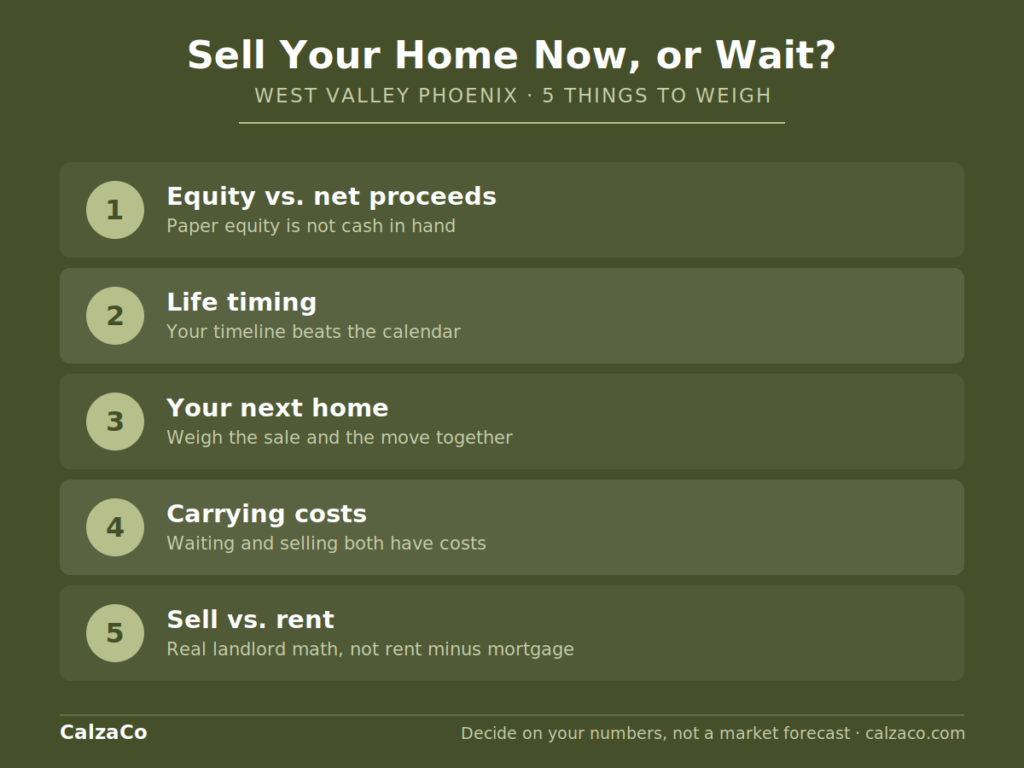
These are not the same number, and confusing them is the most common West Valley Phoenix seller mistake. Home equity is the estimated difference between your property’s value and the debt secured by it. Net sale proceeds are what may remain after the mortgage payoff and transaction-related expenses are deducted. Equity on paper is not cash in hand.
Before you decide, estimate a range, not a single figure: your probable current market value, your mortgage payoff and any other liens, anticipated selling expenses, repair and preparation costs, moving and any temporary-housing costs, and the amount you will need for the next move. Then look at what may realistically remain, not what an online value estimate minus your loan balance suggests. Treat every number as estimated and subject to the final contract and closing statement.
Let life timing lead, not market timing
When you sell a West Valley Phoenix home, put your life timeline ahead of any attempt to pick the perfect market month. A PCS or job relocation, a household change, a need for more or less space, financial strain from keeping the home, or simply whether you can tolerate an open-ended selling process, these usually matter more than the calendar.
The practical question is not only whether the market could be different later. It is whether waiting would improve your position enough to justify the financial, logistical, and personal cost of delaying the move. If waiting does not concretely improve something you can name, it is not really a strategy.
Evaluate the sale together with your next home
This is where a good decision separates from a generic one. A favorable sale does not automatically produce a favorable overall move if the replacement-home cost, financing, commute, or temporary-housing burden does not work for your household. Before selling your West Valley Phoenix home, think through whether you are buying again locally, relocating to a different market, moving into a rental or base housing, whether you can buy before you sell, whether you are comfortable with a contingent offer, and whether you are giving up an existing low-rate mortgage that would be replaced by different financing.
Selling first can sometimes reduce a contingency or clarify your available funds, but whether that actually strengthens your buying position depends on your finances and the next market. Evaluate the two decisions as one.
The real cost of waiting, and of selling
Waiting is not cost-free, but selling is not cost-free either, so compare both honestly before you list a West Valley Phoenix home. Holding the home for the period you are considering carries principal, interest, taxes, and insurance, plus HOA dues, utilities, routine maintenance, landscaping or pool service, likely near-term repairs, vacancy exposure if you move first, and the operational burden of managing another property, especially from a distance. Against that, weigh the expected selling expenses and the practical value of keeping the home.
Notice what this is not: a claim that “every month you wait costs you money.” Some of your payment reduces principal, some owners get real value from continuing to live in the home, and the true incremental cost varies by owner. The point is to compare the cost of holding against the cost and benefit of selling, not to manufacture urgency.
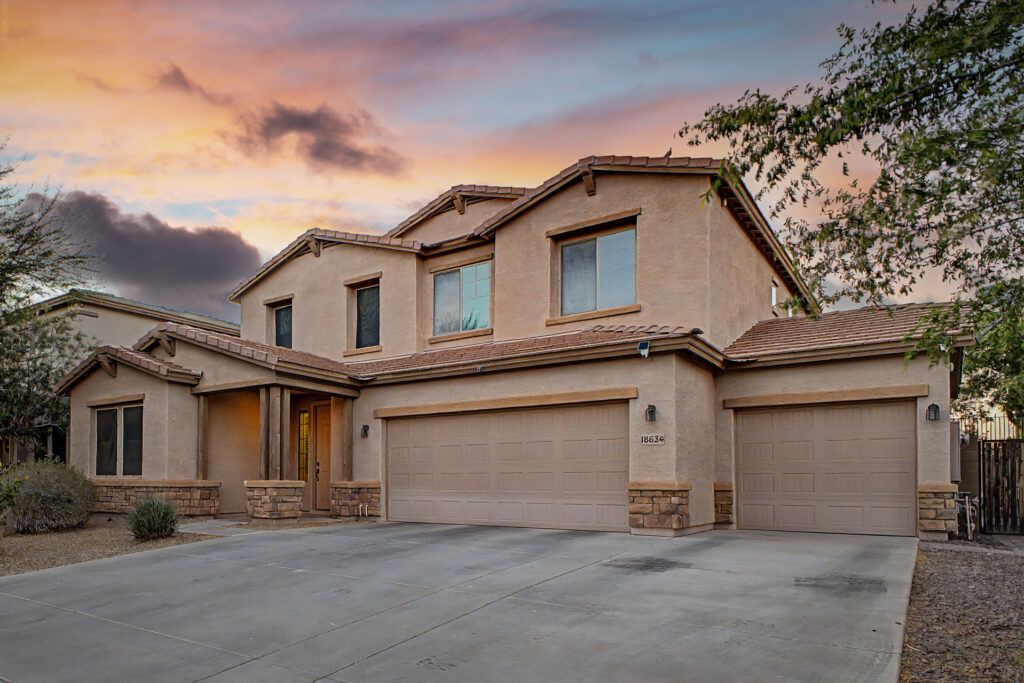
Should you sell your West Valley Phoenix home, or rent it out?
For West Valley Phoenix owners, renting is a distinct financial and operational decision, not a consolation prize if you are unhappy with a possible sale price. And it is not rent minus mortgage equals profit, that math omits the expenses that make or break a rental.
A real comparison includes realistic market rent based on current comparable leases, a vacancy allowance, property-management fees, repairs and capital replacements, HOA rules and any rental restrictions, insurance changes, your mortgage’s occupancy terms where relevant, your distance from the property, your capacity to be a landlord, and the tax considerations, which you should review with a qualified tax professional (the IRS home-sale guidance is a starting reference, not a substitute for advice). Renting may be worth evaluating when realistic rent can reasonably support the property’s full ongoing costs, you have sufficient reserves, the community and loan permit it, and you are prepared to operate as a landlord. Selling may be more appropriate when keeping the property creates persistent negative cash flow, management difficulty, or complications for your next move.
For homeowners facing a PCS or fixed relocation date
A PCS, job transfer, or other fixed relocation date deserves its own note, because the deadline feels like it settles the question. It does not. A PCS creates a deadline for the move, but it does not automatically create a deadline to sell your West Valley Phoenix home. You still need to compare selling, renting, and temporarily retaining the property against your finances, next duty station, available reserves, and willingness to manage a home from a distance.
If a move is coming, weigh your report-no-later-than date and schedule, whether you will depart before the home is listed or sold, power-of-attorney and remote-signing plans (which may be available but must be coordinated with your title company and lender), vacant-home insurance and upkeep, overlapping housing costs, and whether you actually want to be a remote landlord. For the deeper rent-versus-sell decision around orders, our guide to renting or selling when you get PCS orders walks through it in detail.
Sell now vs wait, factor by factor
Use this as a discussion guide for your West Valley Phoenix home, not a scorecard with a verdict, because real situations are not equally weighted.
| Factor | Selling now may deserve more weight when… | Waiting may deserve more weight when… |
|---|---|---|
| Life timing | A move is planned or required | The move is optional and readiness is incomplete |
| Equity | Estimated proceeds support the next step | Usable equity may be limited after expenses |
| Carrying costs | Keeping the home creates strain or risk | Holding costs are manageable and serve a clear purpose |
| Next home | The replacement plan is defined | The next-housing plan is unresolved |
| Rental option | Rent does not support the full risk and costs | The rental case remains workable after realistic expenses |
| Property position | Current competition supports an acceptable strategy | The home needs work or preparation is difficult now |
Is now a good time to sell in West Valley Phoenix?
There is no single market-wide answer, because the West Valley Phoenix area is really a collection of submarkets. A home’s competitive position can vary by city, neighborhood, price range, age, condition, floor plan, nearby builder competition, and active inventory around it. Buckeye, Litchfield Park, Glendale, Peoria, Surprise, Goodyear, Avondale, and Waddell do not behave identically, and neither do two price bands in the same city. The reminder that even one city is not a single market applies to sellers too, as our Peoria submarket breakdown illustrates.
Two practical points for a balanced, selective market. First, launch price matters: in a market with real buyer choice, an ambitious initial price can reduce early interest and later force a reduction, so pricing should reflect recent comparable sales, current competition, and condition, not the number you hope to net. Second, “sell now” does not have to mean “list tomorrow.” A strong third option is to begin the property, financial, and documentation work now, so the home is ready when your broader plan is. New-construction incentives in nearby communities can also compete with resale homes, which our new construction vs resale guide covers.
Before you decide, verify the current picture for your specific property as of the date you are deciding: active, pending, and recently closed comparables in your immediate area; original list versus final sale prices and price reductions; seller concessions; days on market; months of supply within your city, ZIP, subdivision, and price band; competing new-construction incentives; current lease comparables if you are considering renting; HOA rental rules; your mortgage payoff; any solar loan or lease terms; and estimated preparation needs. Conditions vary by property and change over time.
CalzaCo local guidance: We do not pretend to know what the market will do, and you do not need us to. The stronger approach is to compare your estimated proceeds, your carrying costs, your next-home plan, and your sell-versus-rent math against your actual timeline. Get those right, and whether to sell your West Valley Phoenix home now or wait usually becomes clear, regardless of where the market heads.
Frequently asked questions
Should I sell my West Valley Phoenix home now or wait?
Sell now when the move fits your life timeline, your estimated proceeds support the next step, and the costs or risks of keeping the home outweigh the benefits. Wait when you have flexibility, limited usable equity, an unresolved next-home plan, or a sound financial reason to retain the property. Do not base it solely on predictions about future prices or rates.
What should I calculate before selling?
Estimate your home’s likely current value, your mortgage payoff, selling expenses, preparation and repair costs, moving costs, possible concessions, and your replacement-housing costs. Use a range rather than a single projected proceeds number, and treat it as an estimate subject to the final closing statement.
Does a PCS mean I should sell?
Not necessarily. A PCS sets a moving timeline, but you should still compare selling, renting, and temporarily retaining the home based on cash flow, reserves, management responsibilities, your future plans, and the next duty station. The move has a deadline; the property decision does not have to share it.
When does renting make more sense than selling?
Renting may deserve consideration when realistic rent supports the property’s full operating costs, you have sufficient reserves, the community and loan permit it, and you are prepared to manage the property directly or professionally. Selling may fit better when holding creates ongoing negative cash flow or complicates your next move.
Is the West Valley Phoenix market good for sellers in 2026?
It is best described as balanced and selective, and it varies by submarket. Your home’s position depends on its city, neighborhood, price range, condition, and immediate competition rather than a single metro headline. Verify current, property-specific data before deciding.
Ready to decide with real numbers?
A property-specific West Valley Phoenix seller review can compare your likely pricing range, estimated proceeds, current competition, carrying costs, and sell-versus-rent options before you decide whether to list, without any pressure to do so. If you decide selling is the right move, you can review how we approach a West Valley home sale for more information.
We are happy to help you decide whether selling now or waiting is the smarter move for your home and timeline. Book a strategy session and we will help you build a clear plan, click here or call/text 623-242-2900.
This article is general information for West Valley Phoenix homeowners, not financial, tax, or legal advice, not a valuation or net-proceeds quote, and not a prediction of future prices, rates, or market conditions. Values, payoffs, expenses, rents, taxes, and market conditions vary by property and change, and should be verified for your specific home and reviewed with the appropriate licensed professionals before you decide.
+ show Comments
- Hide Comments
add a comment